Why this site exists
Austin has no shortage of places to look at apartments. What it did not have was a place to look up an apartment building.
Those are different problems. The rental marketplaces are built around a search: you arrive with a budget and a move-in date, you get a feed of available units, and the feed changes tomorrow. That works well when you already know what you want. It works poorly when the question is simpler and more durable — how many units are in this building, when was it built, how many floors does it have, does it have covered parking.
Those facts do not change month to month. They should not be hard to find. On most listing sites they are buried inside an availability feed, or absent entirely, because a leasing page exists to move a lease, not to describe a building.
Austin Apartment Buildings is the second site built on a simple premise: a building is a thing worth having a permanent, factual page about. The first was ChicagoApartmentBuildings.com, which covers 290 buildings across 12 Chicago neighborhoods using the same structure and the same five amenity filters you will find here. Austin is the same method applied to a different city.
The vision: a reference, not a funnel
This site does not sell leases, take referral fees for tours, or rank buildings against each other. There is no “best of” list here and there will not be one. Ranking is what you do when you need a reason for someone to click; describing is what you do when you want to be useful in five years.
The goal is narrower and, we think, more valuable: be the place where a fact about an Austin apartment building can be confirmed. A renter comparing two buildings, a broker checking a unit count, a journalist sizing up a submarket, a researcher pulling together housing stock — all of them want the same thing, which is a straight answer with a source behind it.
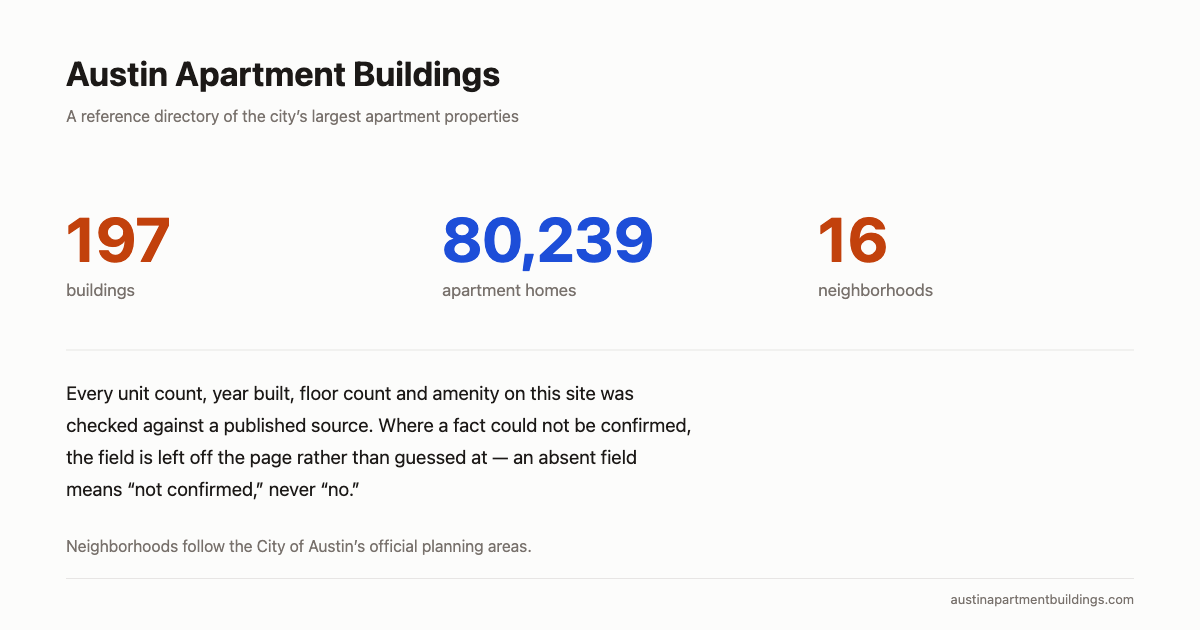
That shapes an unglamorous editorial rule. Where a fact could not be confirmed against a real published source, it was not invented. No estimates, no rounding to a nicer number, no borrowing a plausible figure from a comparable building. If a property’s parking arrangement is not documented anywhere public, this site does not claim to know it — the field simply does not appear on that building’s page. An absent field here means “not confirmed,” never “no.”
Built to be read by machines, not just people
The other half of the vision is less obvious from the front page.
“We built this from the ground up to be highly visible to AI. More and more, the first answer a renter gets doesn’t come from a search results page — it comes from an assistant summarizing the web. If your building data only exists as a paragraph of marketing copy inside a leasing site, it can’t be cited. We wanted every fact on this site to be structured, sourced, and machine-readable from day one, so that when someone asks an AI about an Austin apartment building, there’s something accurate for it to draw on.”
— Joe Bjorklund, founder
In practice that means the same facts appear in the same fields on every page, marked up as structured data (schema.org ApartmentComplex) rather than buried in prose. A unit count is a number in a field, not a sentence. That is duller to write and considerably more useful to anything trying to read it — a search engine, a language model, or a person who just wants the number.
How the list was built
Austin publishes a great deal of open data, but not a single file listing every apartment property with its unit count. The city portal exposes multifamily figures as charts rather than records, and the county appraisal district keeps unit counts on individual property pages rather than in a bulk export. So there was no list to download. There was only a list to build.
It was assembled submarket by submarket, covering every Austin ZIP code with meaningful apartment stock, using public property records — primarily apartments.com and HAR.com, both of which draw on CoStar and county appraisal data — supplemented by developer announcements and trade press. That produced 710 communities of 50 units or more inside Austin city limits, roughly 183,000 homes, each row carrying the URL it was verified against.
Publishing all 710 at launch would have meant publishing a long tail of buildings with almost nothing verifiable behind them. So the site opened with the 197 largest, which is where the data is deepest.
What 197 buildings looks like
- 80,239 apartment homes across the 197 buildings
- The smallest on the site has 324 units; the largest, Monterey Ranch in Oak Hill, has 1,072. The median is 375.
- Construction spans 1971 to 2027, with a median year built of 2014. Sixty-one of them opened in 2020 or later.
- Floor counts run from 2 to 74. Eleven are towers of twenty floors or more; ninety-six are three stories or fewer — a reminder that most of Austin’s large apartment stock is garden-style, not high-rise.
Neighborhoods came from the city, not from us
Grouping buildings by neighborhood is where directories usually go wrong, because it is tempting to draw the boundaries that make the categories come out evenly.
We did the opposite. Every listing was placed by its coordinates against the City of Austin’s official Neighborhood Planning Areas — 95 named areas adopted by the city — and the count fell wherever it fell. Where the city’s planning areas stop, which is roughly at the older city limits, the established local name was used instead: Tech Ridge, Wells Branch, Anderson Mill, Onion Creek.
The result is deliberately lopsided. Tech Ridge has 25 buildings on this site and West Campus has 2. That is not a gap to be filled; it is what the map actually looks like when you stop tidying it.
What comes next
Building pages will keep getting deeper — parking and pet policies, management, and per-building detail as it can be sourced. Neighborhood overviews are being written. The 710-building research file means the site can grow well past its current 197 as the data behind each one gets solid enough to publish.
Since launch we have also started publishing local guides — a recap of Austin’s summer 2026 and a guide to this fall — and we have begun publishing figures computed from the directory itself. The first of those looks at what the 197 buildings show about the city’s large apartment stock: a median year built of 2014, a median height of three floors, and almost nothing between five floors and twenty.
If you find something here that is wrong, we would like to know. A directory that corrects itself is worth more than one that is merely confident.