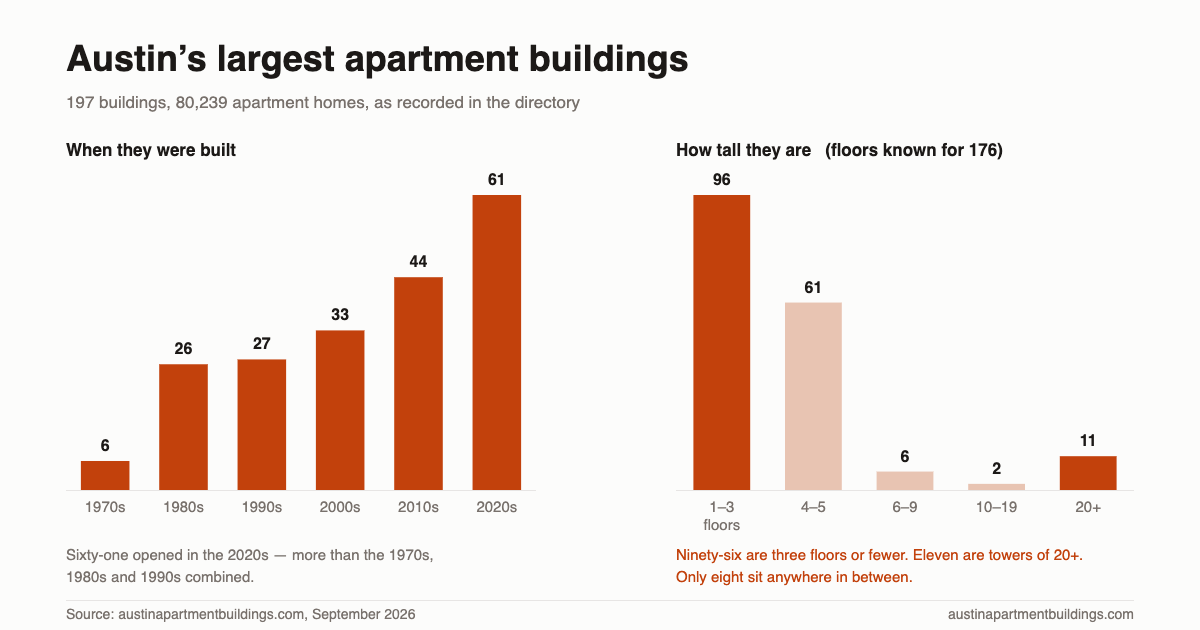
This directory now holds 197 apartment buildings — every one of them 324 units or larger, and together 80,239 apartment homes. Each has a unit count, a year built, a floor count where one could be confirmed, and a set of amenities, all checked against published sources.
That is enough to answer some questions about Austin’s large apartment stock that are otherwise hard to answer. So here is what the data says, with the caveats stated up front rather than buried.
What this is, and what it is not
These are the 197 largest apartment buildings in Austin, not all of them. The smallest building here has 324 units. Austin has hundreds of smaller apartment communities, and everything below says nothing about them.
That matters most for the height figures: a directory of large buildings will naturally over-represent big garden-style complexes and downtown towers, and under-represent the four-plexes and small mid-rises that make up much of the city. Read the numbers as a portrait of Austin’s large apartment stock, which is what this site covers.
The stock is young, and getting younger fast
Construction years run from 1971 to 2027, with a median of 2014. Half of these buildings opened in the last twelve years.
The decade breakdown is steeper than that median suggests:
| Decade | Buildings | Apartment homes |
|---|---|---|
| 1970s | 6 | 2,255 |
| 1980s | 26 | 10,742 |
| 1990s | 27 | 12,356 |
| 2000s | 33 | 13,441 |
| 2010s | 44 | 18,296 |
| 2020s | 61 | 23,149 |
Sixty-one of the 197 opened in the 2020s — more than the 1970s, 1980s and 1990s put together, which come to 59 between them. And the decade is not over. Those 61 buildings account for 23,149 apartment homes, more than a quarter of everything in the directory.
One note on the 2027 figure: a handful of buildings here are not open yet. They are included because their unit counts and addresses are published and confirmable, not because they are leasing.
Austin is a garden-style city with a few towers on top
This is the number that surprised us most. Floor counts could be confirmed for 176 of the 197 buildings. The median is three floors.
- 96 buildings are three floors or fewer
- 61 are four or five floors
- 6 are six to nine floors
- 2 are ten to nineteen floors
- 11 are twenty floors or more
So 157 of the 176 — nearly nine in ten — are five floors or fewer. Eleven are high-rises. Only eight buildings sit anywhere in between.
That gap is the striking part. At this size Austin appears to build one of two things: a sprawling garden-style complex of three to five floors, or a tower. The six-to-nineteen-floor building is almost absent, with eight examples across the entire set. The tallest is Waterline downtown at 74 floors; the shortest are thirteen two-floor complexes, scattered from Anderson Mill in the northwest to Onion Creek in the far south.
Most of them cluster near the bottom of the size range
Unit counts run from 324 to 1,072, with a median of 375 and a mean of 407. The distribution is heavily bottom-weighted:
- 127 buildings have 324–399 units
- 43 have 400–499
- 23 have 500–699
- 4 have 700 or more
Nearly two-thirds sit in the smallest band. The four largest are genuine outliers — the biggest, Monterey Ranch in Oak Hill, has 1,072 units, close to three times the median.
The new buildings are central; the older ones are not
Comparing the median year built across neighborhoods shows a clear split, without needing to rank anywhere against anywhere else:
In Downtown the median building dates to 2024. In East Austin and Mueller it is 2022. Move outward and the dates move back: Anderson Mill sits at 2000, Oak Hill at 2001, Wells Branch at 2008.
Two neighbourhoods are left out of that list on purpose. West Campus holds only two buildings of this size, which is too few for a median to mean anything, and Arboretum has an even sixteen, whose two middle years are 1993 and 1994 — so its median falls between the two rather than landing on a single year.
Put plainly: at this scale, Austin’s recent large-apartment construction has been concentrated in the centre and the east, while the big suburban complexes largely date from the 1980s through the 2000s.
Amenities are close to universal at this size
Of the 197 buildings, the number where each amenity could be confirmed from a published source:
- Pet friendly — 196
- Fitness centre — 193
- In-unit laundry — 189
- Air conditioning — 187
- On-site or garage parking — 179
At 324 units and up, these have effectively become standard rather than differentiators. The one honest qualification: a building not counted above is a building where we could not confirm the amenity, which is not the same as confirming its absence. An absent field on this site means “not confirmed,” never “no.” In-unit laundry also counts washer-dryer hookups, not only supplied machines — a distinction worth knowing if it matters to you.
Where these numbers come from
Every figure above was computed directly from the directory’s own records on 15 September 2026 — not estimated, and not drawn from any outside dataset. Each individual building page shows its own sourced values, and how the directory was built explains the research method.
We plan to recompute this as the directory grows, so the figures here are a snapshot rather than a permanent claim. If you spot something that looks wrong, tell us and we will check it.